

AI ENABLEMENT FOR ORGANIZATIONS READY TO MOVE BEYOND THE PILOT
The technology isn't the problem.
Your organization's readiness is.
Built on enterprise L&D and change management discipline, not theory.
87% of companies have AI running somewhere. Only 6% are seeing enterprise-level results. The difference isn't the model. It's whether the people, leaders, and culture were ready for it.
Everyone's deploying AI.
Almost no one is ready for it.
Most AI initiatives don't fail because the technology is weak. They fail because organizations aren't built to sustain them. About 95% of AI pilot programs stall before delivering meaningful impact.
Your people need to understand what changed and why it matters. Your processes need updating. Your culture needs permission to experiment without panic. And your leaders need the confidence to scale what's actually working.
L&D meets AI. Change management meets transformation. That's our world.
~95%
of AI pilot programs stall before delivering meaningful revenue impact. The common explanation is "bad tech." The real explanation is almost always organizational.
Aggregated from McKinsey, BCG, and Gartner research
THE AI INTEGRATION FRAMEWORK
Five phases from where you are to where AI works
Most frameworks blur the line between readiness and implementation. Ours doesn't. Each phase has a purpose, and the sequence matters.

Curious where your organization stands?
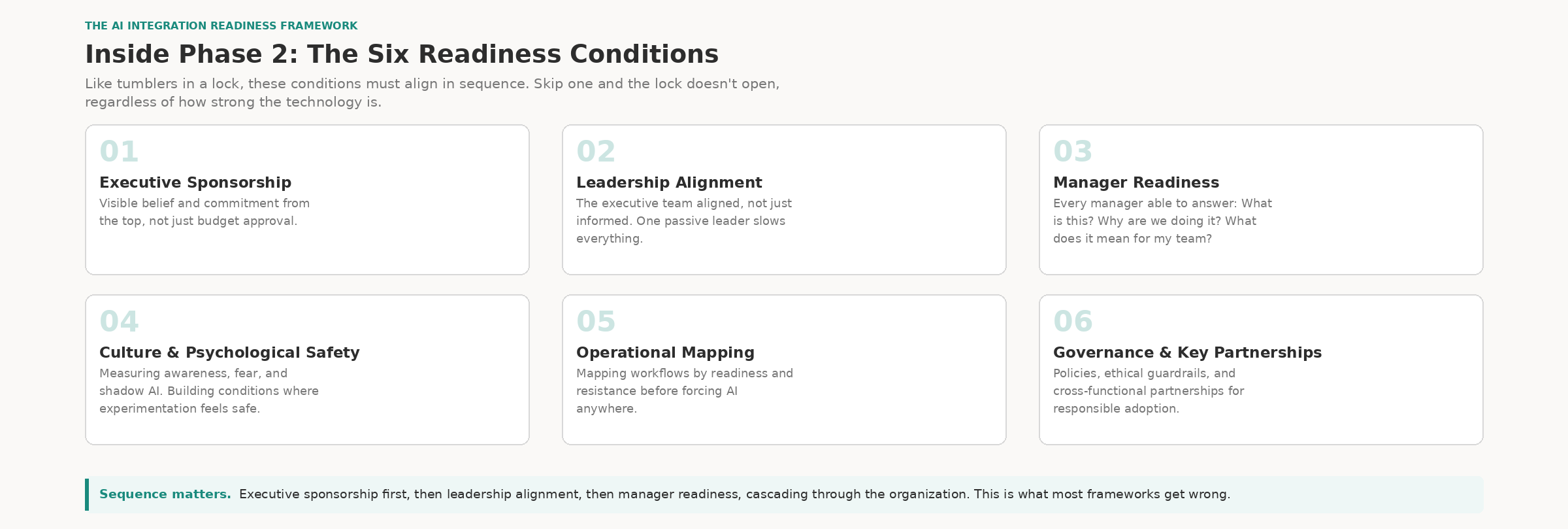
The 37-question diagnostic takes 10 to 12 minutes and gives you an immediate read across all six readiness conditions.
WHO’S BEHIND THIS
Built on 25 years of doing the work, not watching it.
Hewman.ai is led by Chris Allen, a senior Learning & Development and AI enablement professional who has spent his career at the intersection of people development, organizational change, ethics, and emerging technology inside Fortune 500 organizations.
Chris has spent 25 years building and leading large-scale learning, change, and ethics programs at Fortune 500 organizations. Former Ethics Officer at Blue Cross Blue Shield of Minnesota. L&D leadership across 3M, Target, and Kaplan University, where he scaled professional eLearning from standing up to $33.5M across 30 regulated industry verticals. He teaches AI governance and enablement for the American Management Association.
The AI Integration Readiness Framework above was validated against research from MIT, McKinsey, BCG, and Gartner.
WHO WE WORK WITH
We work with mid-size and enterprise organizations across industries where people, process, and culture are the real barriers to AI working at scale.
The framework above is how we get there. Twenty-five years of L&D, instructional design, change management, and ethics work is what stands behind it.
HR & Workforce - People operations, talent, learning functions across sectors
Professional Services - Consulting firms, law, accounting, staffing
Manufacturing - Construction & trades, industrial operations, supply chain
Insurance & Benefits - Health plans, benefits administrators, brokers, and HR-tech platforms
Retail & Consumer - Multi-location retail, e-commerce, hospitality
Technology & SaaS - Product companies, platforms, internal operations
Nonprofit & Education - Workforce development, associations, higher ed
Real Estate & Property - Commercial, property management, brokerage operations
If your organization has more than 50 people and AI adoption is your goal, we should talk.
The Numbers Behind the Gap
85%
of employees save 1-7 hours weekly with AI, but 40% of that time is lost to fixing mistakes and rework
Workday Newsroom, January 2026
8.6%
of companies have AI agents running in production. 63.7% still lack a real AI strategy.
Recon Analytics / TechRepublic, January 2026
78%
of organizations plan to integrate Gen AI across functions, but planning without readiness is just optimism
Wharton / Knowledge at Wharton, October 2025
THOUGHT LEADERSHIP
The AI Readiness Series
A four-part deep dive into what separates organizations that succeed with AI from those that stall. Published on LinkedIn.
01
02
03
04
How This Works

Discovery Conversation
A real conversation about where you are: what's working, what's stalled, and what you're not sure about. We ask the questions most consultants skip.
30-45 minutes, no cost

Straight Talk Proposal
Based on what we learn, we recommend the right starting point: a diagnostic, a phased engagement, or sometimes a conversation about what needs to happen first.
Within one week

Partnership, Not a Project
We bring frameworks, facilitation, and organizational experience. You bring the people who make your business run. This integrates with your existing L&D and change infrastructure, not around it.
Ongoing
Investment
Engagements designed for organizations serious about scaling AI beyond pilots.
AI Readiness Diagnostic
Starting at $5,500
Evaluates all six readiness conditions through stakeholder interviews, a manager pulse survey, policy review, and operational conversations. Delivers a scored readiness map, gap analysis, and board-ready executive briefing with a recommended phasing plan.
3-4 weeks
AI Integration Engagement
Starting at $18,000
Covers whatever combination of phases your organization needs, from Pre-Readiness and Readiness through Strategy, Workforce Activation, and Implementation. Each phase is scoped with clear deliverables and milestones. You see the full journey and commit phase by phase.
Phase 1: Readiness - building the six conditionsPhase 2: Strategy - use case prioritization, rollout planningPhase 3: Workforce Activation - communication, leader modelingPhase 4: Implementation - pilots, reskilling, scaling
Scoped from your diagnostic findings and sized by the number of phases required and your organization's scale. For organizations over 5,000 employees, engagements are scoped accordingly.
Scoped per engagement
For organizations seeking ongoing strategic guidance, AI Advisory Retainer partnerships are available from $2,500/month, including twice-monthly strategy sessions and 8-10 hours of dedicated advisory time.
The window for readiness advantage is open.
It won't stay that way.
The organizations winning with AI in 2026 aren't the ones with the best algorithms. They're the ones who figured out the people part first.